China and Russia Deepen Arctic Shipping Ties as Europe Seeks a Response
Moscow and Beijing agreed to expand freight along Arctic corridors just after the EU unveiled its own Arctic strategy, but analysts say Europe has limited leverage.
By News Media House Staff ·
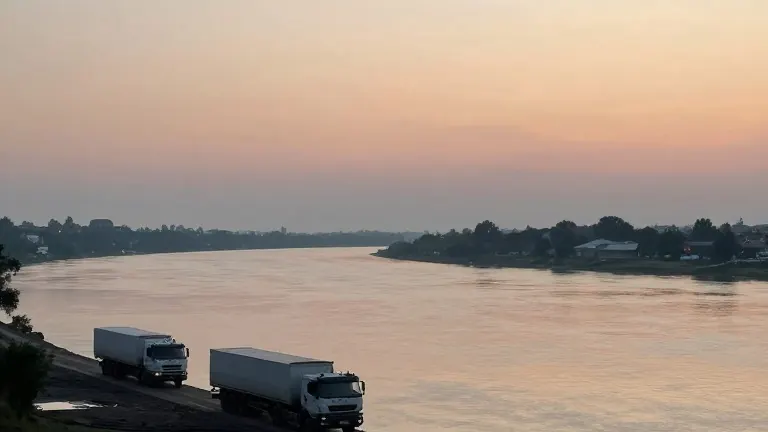
China and Russia are strengthening their hold on Arctic shipping routes, turning the fast-warming region into a new arena of geopolitical competition with Europe. Last week, Moscow and Beijing agreed to expand freight traffic along Arctic shipping corridors, increase services between their ports and deepen cooperation on building polar vessels.
The agreement followed the European Union's release of a new Arctic strategy designed to counter growing Russian and Chinese influence in the region. EU foreign policy chief Kaja Kallas pointed last week to the region's strategic value. Analysts told CNBC, however, that Europe's ability to challenge the emerging partnership is limited.
The reason lies in the division of roles. Moscow controls the Northern Sea Route, including shipping permits, transit fees and a large fleet of nuclear icebreakers. Beijing supplies the cargo, vessels and industrial capacity needed to develop the corridor. Europe has limited icebreaker capacity and Arctic infrastructure, despite being a major destination market.
The route is gaining appeal as disruptions in the Middle East expose weaknesses in established corridors. According to data from Fertmax FZCO, cargo moving between Asia and Europe via the Northern Sea Route could complete the trip in 18 to 22 days, roughly 35% faster than the 28 to 35 days needed through Suez. For Russia, the route offers a way to redirect energy exports toward Asia as Western sanctions limit access to European markets. For China, it adds a trade artery that could lessen reliance on traditional maritime chokepoints.
David Roche of Quantum Strategy & Geonomics said the significance lies in Russian energy shipments to China. In his words, this will "increase China's control over Russia in terms of Russia's dependence on China to sell its energy to compensate for losses of its gas markets in Europe."
Europe is not without options. Its strategy calls for more European icebreaker capacity, stronger maritime surveillance and infrastructure linking Arctic trade networks to European markets. It also proposes a maritime security hub and better protection for undersea cables, reflecting concern over Russian military activity. Experts said Europe's leverage rests mainly on being a major destination market and on the presence of large shipping companies that have avoided the Arctic because of environmental and commercial risks. Engaging with the corridor could also deepen reliance on Russian-controlled infrastructure. Daeijin Lee, a former global head of research at Fertmax FZCO, said Western operators face sanctions, insurance and compliance hurdles. "The Arctic gives diversification, not independence," he said.
For now the Arctic remains a marginal player in global shipping. Roche estimates it accounts for about 0.3% of global shipping and could reach about 1% by 2030. Figures from Rosatom and CNBC calculations based on UN Trade and Development data support the 0.3% estimate: 37.02 million tonnes transited the Northern Sea Route in 2025, against 12.72 billion tonnes of global seaborne trade in 2024. The Centre for High North Logistics said only 3.2 million tonnes, less than a tenth, involved vessels making the full transit.
Traffic may be rising. By the end of September 2026, the route had recorded 104 confirmed transit voyages carrying an estimated 3.7 million tonnes, more than the 3.2 million tonnes logged across the whole 2025 season. Much of the cargo is Russian oil, liquefied natural gas and other commodities rather than international container shipping.
Obstacles remain. Ice limits navigation for much of the year, and specialized vessels, insurance premiums and Russian transit fees can erode the savings from shorter voyages. Matthew Wright, an analyst at Kpler, said operators need reliable year-round services, so the route is poorly suited to replace established corridors. Lee expects it to develop as a seasonal express route for selected high-value cargo. Over the long term, climate change could change the picture: a study in the WMU Journal of Maritime Affairs projected that melting polar ice could lift annual transit capacity to between 127 million and 463 million tonnes by 2050.
Originally published by News Media House · Source: CNBC
More News · National news · Report a business · Got a Story?